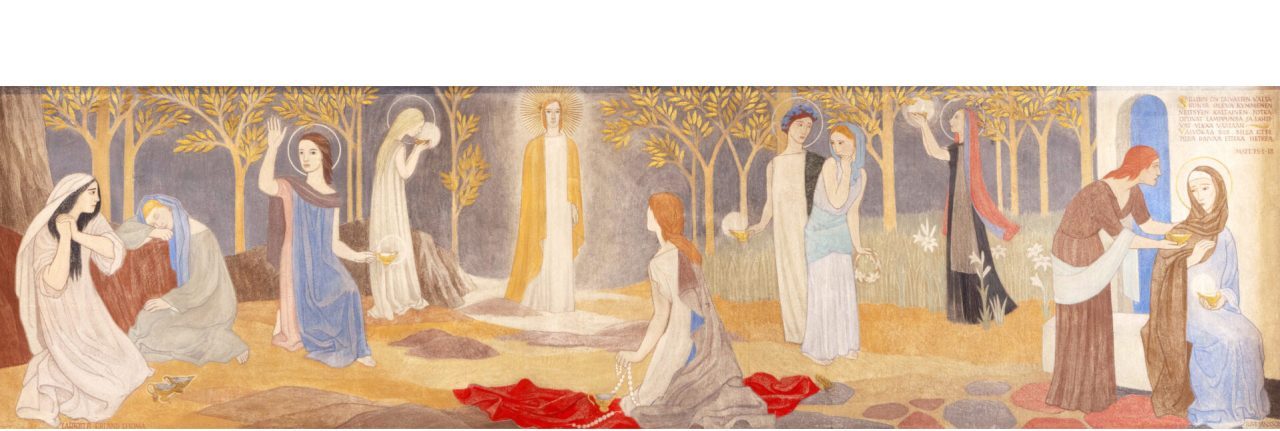
Come forth Lazarus!...preceded a little before in scripture by “Jesus wept”, in fact the shortest sentence in the New Testament, between those two sentences Jesus receives a disbeliever’s word, to not open the tomb because beloved Lazarus most likely by now stinketh (King James Version translation). Jesus’ tears, tears beyond empathetic sentiment but of heart-struck bereavement, remember Jesus is fully human, bearing the complete sphere of human experience; spanning the complete breadth of mortal existence.
But he is still also God, which raises an interesting distinction between God and humankind when a man sits on the line that divides the two. St. Paul speaks in a foreign idiom when he speaks of human existence in God as per Greek poetry: “In whom we live and move and have our being” (Paul citing Greek writer Epimenides in Acts 17:28). The distinction could be restated as what does it mean to be immersed in the water when you are the water?
One of ideas of note coined by the late Vietnamese Buddhist writer Thich Nhat Hahn was “interbeing“. The idea of interbeing is to spread-out the notion of being so that we can see that we are all interconnected. Interbeing is founded on a different philosophical backdrop to Christianity, as far as i can make out – it advances that because we are all enfolded in each-other’s lives – especially in a globally interconnected world – in that sense we all participate in each-other’s beingness.
In an economist’s frame of understanding – this interbeing is erased by the anonymity of the balance sheet – but it is still there. My being, sat at a table peeling/eating an orange, is meshed together with the fruit-picker who picked-up that individual item of fruit. There is of course the famed supply-chain joining one end to the other and i participate in interbeing with every one that links us together.
If the interbeing of Nhat Hahn is rhizomic (like thickly & randomly interconnected roots of a tree), the being of theism is vertical and hierarchical, ultimately we borrow our being from God and without him we would just cease to exist. Just where does the incarnate word fit in the interbeing view of existence? Thic Nhat Hahn gives an wonderful dual-metaphor for interbeing, it is like the manure-heap out of which a beautiful flower springs forth, and it is equally just like a child making a living from the un-recycled waste exported abroad to her own country.
The necessity is of something beautiful mutually dependent on what is not. And everything is like this and is this metaphor writ-large. Given that the Judeo-Christian frame suits an individualistic society, that sure, we all have responsibilities to others but our primary responsibility is vertical, the metaphor for interconnectedness that is neatly encapsulated in “interbeing” suits a religion that does not accede to God.
How to make use of a very useful idea when its natural home is God-less?
To return to the manure heap metaphor, it isn’t just good for nothing, it is good for fertiliser. A duo of horticultural metaphors gets their Gospel debut in Mark’s account, in the Parable of the Mustard Seed, faith is likened to a mustard seed, but as every gardener knows you have to pay good attention to the soil, to cultivate and care for the seed so it germinates and sprouts.
But the manure-heap which is good for nothing i liken to a certain English expression. “You know what thought did?“. You know what thought did is the riddle-like reply given to people who have assumed to much (usually preceded by “Well I thought x,y,z..(but i was wrong)”. It is rhetorical, although it does have an unacknowledged second half (“…it followed a manure-cart thinking it was a wedding carriage”). I am guilty of thinking and overthinking. I suppose my first dalliance with things Buddhist started 25 years ago when i wished to detach myself from various feelings of inadequacy. Plus ca change.
That phase of personal interest drew to a close, I now have data aplenty to make sense of the Catholic faith but which has little to do with the Catholic faith. If Jesus said Without my word you can do nothing – Jesus doesn’t exactly say that but the gist of it is true – then words that are not at least indirectly in reference to him are ineffectual and impotent. This is where interbeing and the manure-heap is a prompt to rethink myself as the disgraced “black” sheep of Matthew, Mark and also the Gospel of Thomas.
One of the many ways you can get lost is by alcohol. It is a popular method of obtaining a temporary form of loss-of-self. Music and alcohol (or the two combined)…they are the cheap methods for this. The centerpiece doctrine of Buddhism is lack of self, which Buddhists seem to elevate to God-level dogma. But since it is easier to gain respite from Western Man’s unremitting self-regard by recourse to the Western method, than use to use Buddhist method, it is a good departure point away from Buddhism.
All of which suggests that the legit Western method is the vertical one, looking up to God not in servile fear, but dependence and trust. Like the lost sheep named Lazarus who is being carried back home. After all, what need is there for detachment from one’s past misdeeds when we are vouchsafed that they are covered by the blood of Christ?
The interbeing that bathes us in his blood-tide i.e. Jesus who participated in human existence became the ocean so that we can do the same, swim in him and live to fullest extent. Where does this leave the metaphor of the manure heap? In this writing. It’s the manure heap out of which the only flower is the name:“Jesus”
 Topical Catholic